Fallow Deer and Deer

Breeding

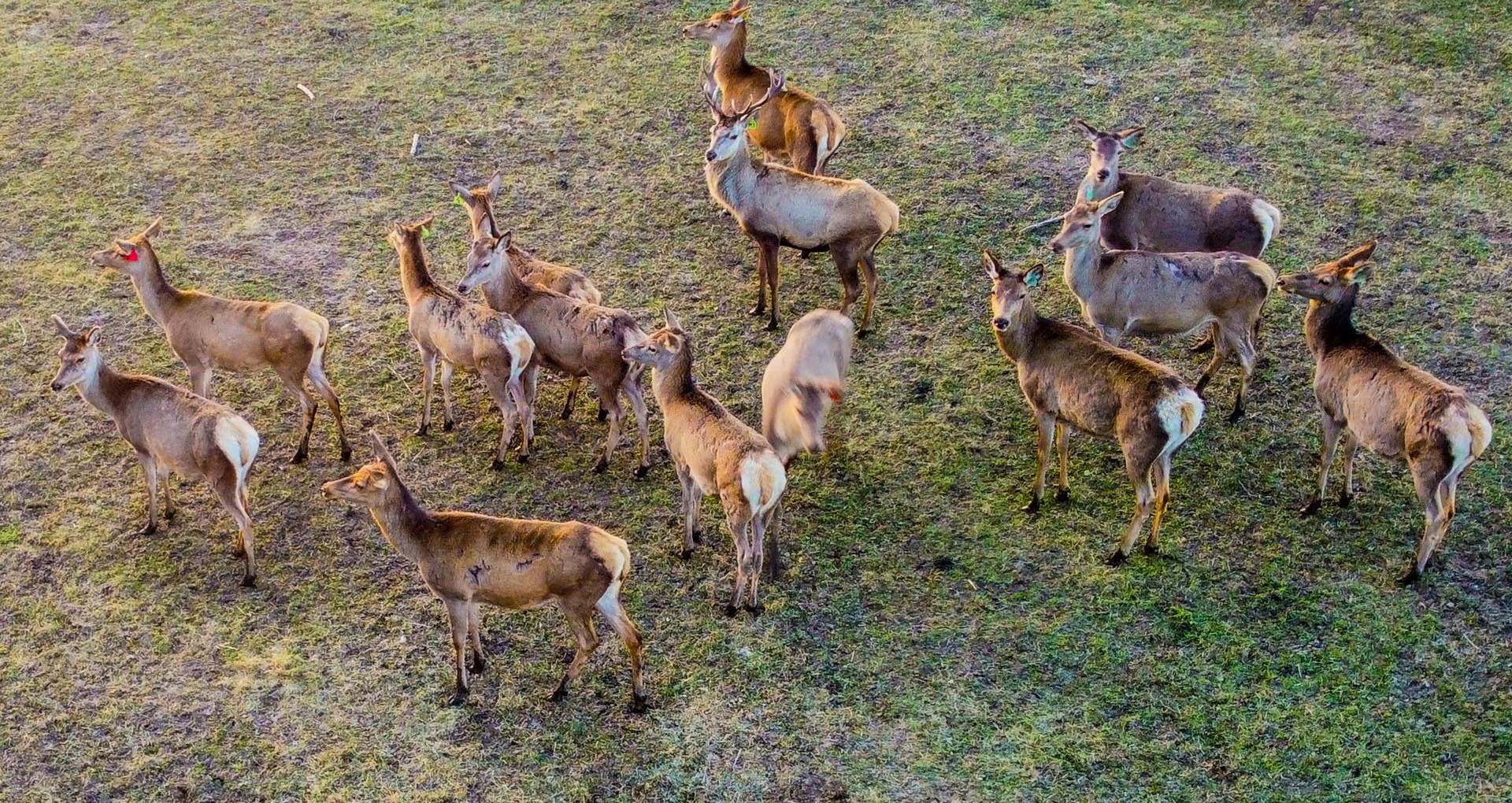
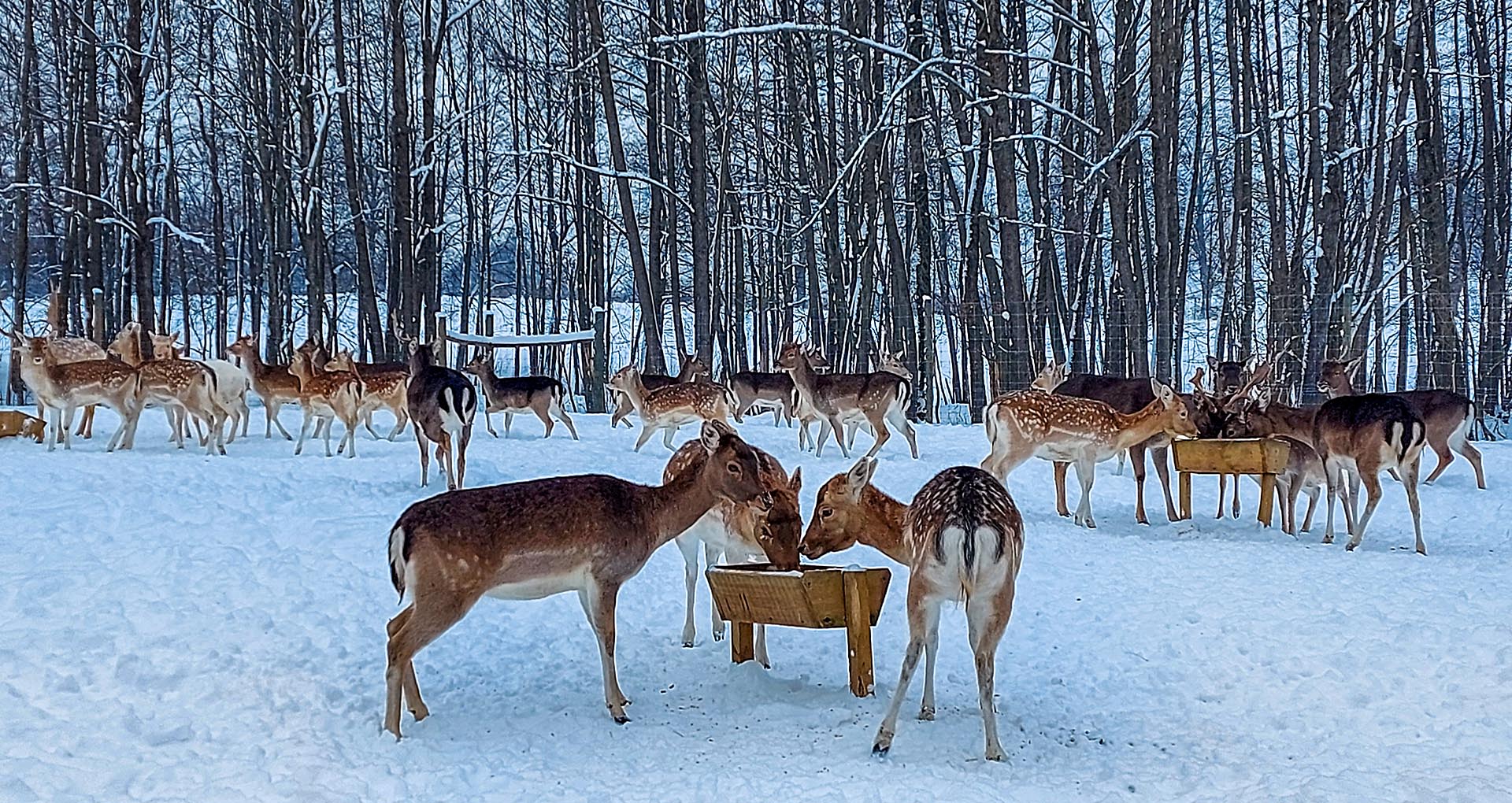
In 2018, we started breeding fallow deer and deer on our organic farm. Professionally prepared pastures and fences accepted the first animals that came to us from Germany and several farms in Poland. Our animals are in excellent condition and the welfare is constantly monitored by the District Veterinary Doctor.

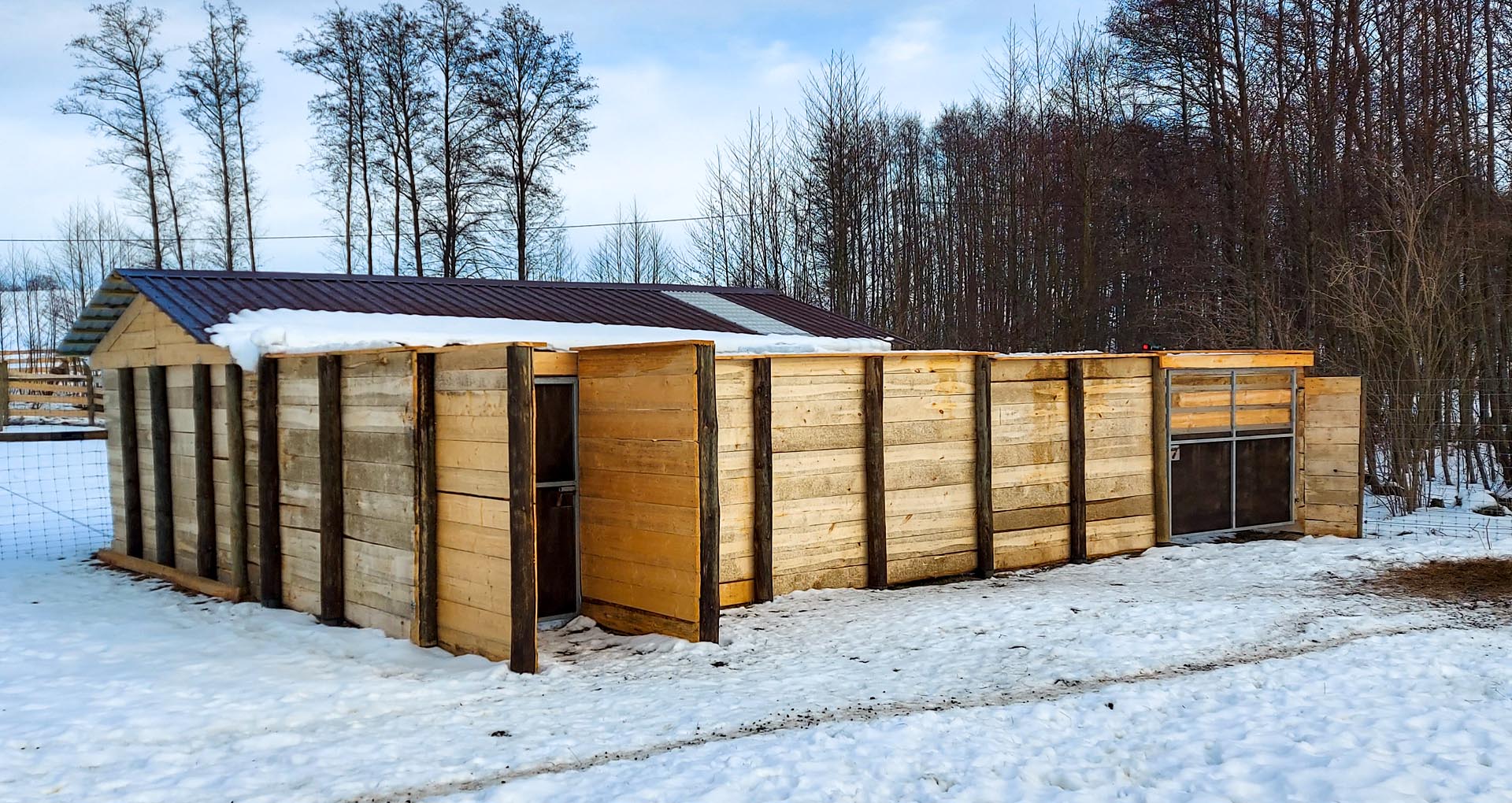
Our breeding farm is equipped with a professional trapping farm with a restraint, which allows us to constantly control the herd and to properly conduct veterinary procedures.

We sell bulls, hinds, calves and soon organic fallow deer and farm deer.
Contact us

Deer

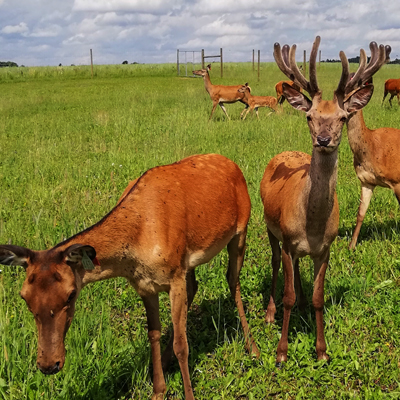
Red deer (Cervus elaphus) - a species of large land mammal from the deer family (Cervidae).
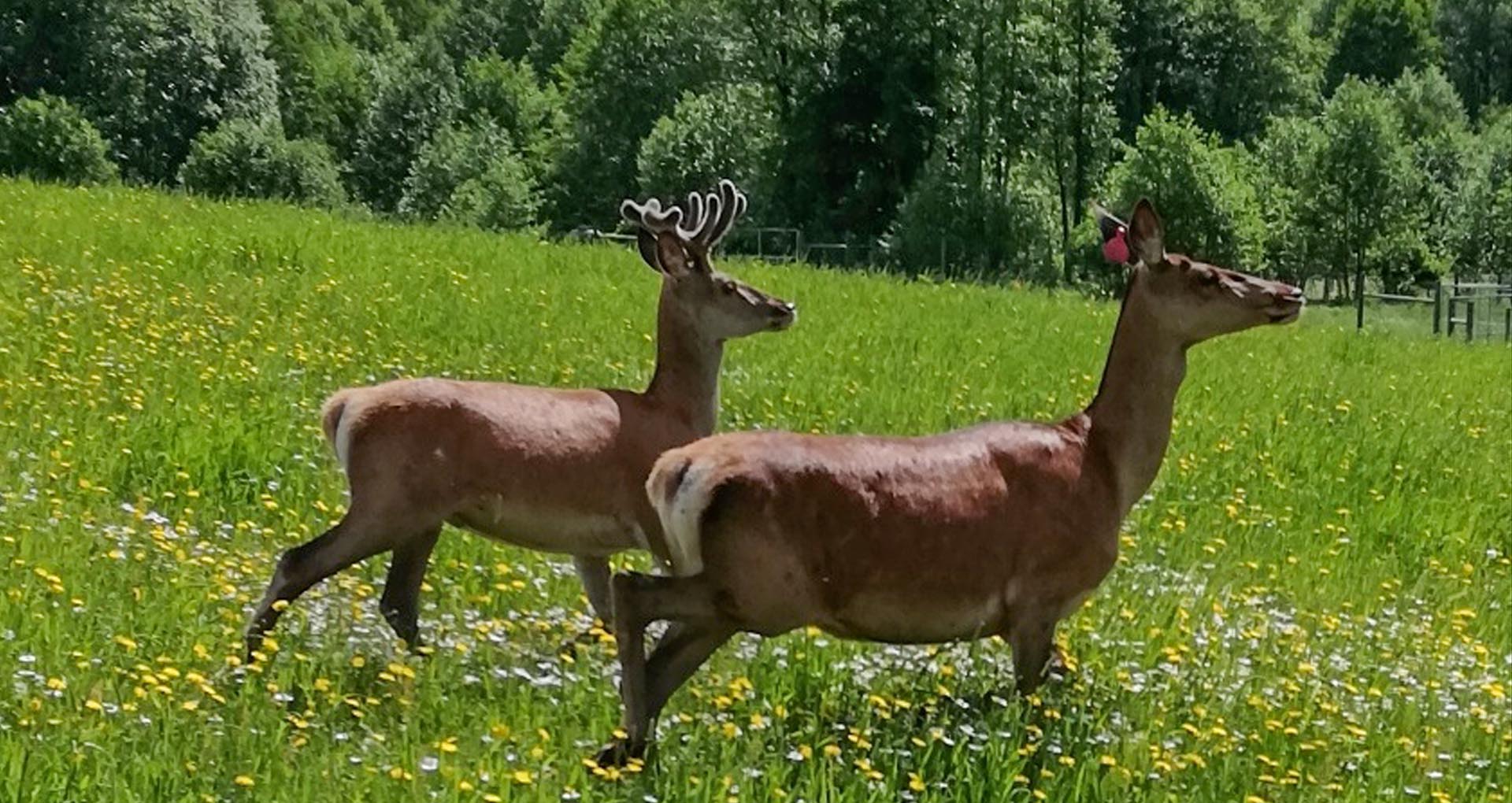
One of the largest species of the deer family. The red deer are usually uniform in color, only the young are spotted on the sides and back. Brown to reddish in summer, grayish in winter, with a darker neck in males. They have longer hair on their necks, forming a kind of mane overhanging the withers. Grandle (hooks) are rudimentary fangs located in the jaw, with no incisors in the jaw. In the lower jaw, next to 3 incisors on each side, there is one glue, then there is a diastema and a row of lateral teeth; 3 premolars and 3 molars each. The permanent dentition of a deer is 34 teeth. The dental formula is as follows: jaw: 0133; lower jaw: 3133. P3 is bipartite (p3 is tricuspid).
The red deer found in Poland can reach 2.5 m in length and the height at the withers up to 1.5 m. The body weight of a large deer reaches 350 kg (maximum 497 kg). The weight of the deer found in Poland varies between 150-160 kg, with the largest size reaching individuals around 10-14. years of age - males 224 kg, females 132 kg. The difference in weight is influenced by the age and geographical range of individuals of a given population - bulls in the 3rd age class, ie at 11 years of age, and older from the Greater Poland population weigh 117 kg on average; The bulls from the Masurian population weigh 137 kg on average in the 3rd age class, and the bulls from the 3rd age class from the Lublin population weigh 156 kg; The doe weighs an average of 70-80 kg. 7-12 years old deer show the best condition. The weight depends on the area of ​​occurrence and the availability of food.
The red deer is covered with short and close-fitting hair. Red deer hair is gray-brown in winter and rusty-brown in summer, and is replaced twice a year. The top of the head, neck, abdomen and legs are darker in color than the rest of the body. The tail (flower) is 15 cm long.
Deer have a very good sense of smell and hearing and are very skittish.
Read More

Antlers

All red deer subspecies are characterized by large antlers (wreaths) with round poles and a varied number of legs. The antlers are shed at the turn of February and March (young bulls only in April) and begin to regrow in early spring, reaching the largest size in early summer in 12-14-year-old individuals. This age is only approximate, because in the ecotypes of the Carpathian or Masurian deer this period falls on 11-12 years.
The antlers growing out of pots consist of two poles. Each of the poles is distinguished by a rose (a circle with potting), pearls (small thickenings) and branches (branches, the number of which can be up to 30) and grooves (relics of blood vessels and nerves). The first branch above the rose is the so-called an oysterocele, then an oyster cap, and then an oyster. Above the support there may be a fork (2 legs forming the letter V) or a crown (3 or more legs are called a crown). On a well-developed wreath, there may be additional legs on the support, or a leg under the crown, the so-called wolf's leg (sometimes "redundant") is also included in the crown. The number of legs and the weight of antlers increases with the age of deer until 10-14 years of age, in older animals it decreases (this process is called antler regression). It is rare to find a bull so old that the antlers have completely disappeared. A bull that has not developed antlers is called a monk, and an old bull with hoes without legs is called a shawlman. Due to the high risk of hitting another bull during the rutting season, the shifter is selected first. Damage (disease) to the testicles leads to incorrect development of the antlers. It does not take the form of branching ticks, but low pyramids (cones) with an irregular surface. A male wearing such antlers is called a wig maker.
In Poland, the weight of a wreath is clearly differentiated between Carpathian and Masurian deer and the rest of the population. Bulls from the Carpathians and Masuria usually have heavier antlers 6-12 kg, and the remaining ones in the range of 3.5-8 kg. There are, however, exceptions. The female, called the doe, has no antlers.
Read More

Lifestyle

It is a living animal by nature, but under the influence of external factors (the presence of predators, people) disturbing its peace and sense of security, it leads mainly at night, hiding in the forest thickets during the day. It starts feeding after dusk, and in the morning it returns to its hideout. During the day, it forages in places where it does not sense any danger. Deer only sleep 60-100 minutes a day.
Deer feeds on shoots, leaves, bark and fruits of trees and shrubs, grasses, grains, herbs, potatoes, beets, and in winter - dried grasses, mosses, lichens, buds and young shoots of conifers. They also go out to farmland tempted with beets, cabbage, potatoes and cereals.
The bulls, especially during the rut, enjoy mud baths in the so-called bathing areas. Then they rub against trees (paint) to get rid of parasites. During rutting, they can lose even 10 to 15% of their body weight, because the deer does not eat food during this time.
Deer in the wild lives up to 12-15 years (there are even 20-year-old individuals). In farm conditions, until 23.
Rykowisko jeleni rozpoczyna się w drugiej połowie września. Byki i łanie osiągają dojrzałość płciową w drugim roku życia, ale do rozrodu przystępują zwykle samce powyżej 5 roku życia (najczęściej byki w wieku od 7. roku życia wzwyż). Łanie rodzą pierwsze młode w wieku 3 lat. Po ok. 234 dniach ciąży, samica rodzi w ukryciu jedno, rzadziej dwa młode, zwane cielętami. Poród przypada na maj-czerwiec. Kiedy tylko młode są zdolne do wędrówki za matką, co następuje po kilku dniach od narodzin, razem z nią dołączają do stada. Żółtawobiałe plamki na bokach i grzbiecie młodych zanikają jesienią. Cielęta żywią się mlekiem matki przez 8-10 miesięcy, pozostając przy niej do trzeciego roku życia.
Ciekawostką jest, że jelenie byki w okresie rykowiska (3-4 tygodni) w ogóle nie żerują, pijąc jedynie wodę. W tym czasie byki tracą nawet 20% masy swojego ciała. Po okresie rykowiska byki zaszywają się w ostojach, regenerując siły i stopniowo odbudowując swoją masę.

Rykowisko jeleni rozpoczyna się w drugiej połowie września. Byki i łanie osiągają dojrzałość płciową w drugim roku życia, ale do rozrodu przystępują zwykle samce powyżej 5 roku życia (najczęściej byki w wieku od 7. roku życia wzwyż). Łanie rodzą pierwsze młode w wieku 3 lat. Po ok. 234 dniach ciąży, samica rodzi w ukryciu jedno, rzadziej dwa młode, zwane cielętami. Poród przypada na maj-czerwiec. Kiedy tylko młode są zdolne do wędrówki za matką, co następuje po kilku dniach od narodzin, razem z nią dołączają do stada. Żółtawobiałe plamki na bokach i grzbiecie młodych zanikają jesienią. Cielęta żywią się mlekiem matki przez 8-10 miesięcy, pozostając przy niej do trzeciego roku życia.
Ciekawostką jest, że jelenie byki w okresie rykowiska (3-4 tygodni) w ogóle nie żerują, pijąc jedynie wodę. W tym czasie byki tracą nawet 20% masy swojego ciała. Po okresie rykowiska byki zaszywają się w ostojach, regenerując siły i stopniowo odbudowując swoją masę.
Read More

Reproduction

The deer rut begins in the second half of September. Bulls and does reach sexual maturity in the second year of life, but males over 5 years of age usually commence breeding (mostly bulls from 7 years of age and above). The hinds give birth to their first cubs at the age of 3. After about 234 days of pregnancy, the female gives birth to one, or less often two, calves in hiding. Childbirth is in May-June. As soon as the young are able to follow their mother, which takes place a few days after birth, they join the herd with her. The yellowish-white spots on the sides and back of the young disappear in the fall. The calves feed on their mother's milk for 8-10 months, staying with her until they are three years old.
An interesting fact is that during the rutting season (3-4 weeks) deer stags do not feed at all, drinking only water. During this time, bulls lose up to 20% of their body weight. After the rutting season, the bulls hide in refuges, regenerating their strength and gradually rebuilding their mass.
Czytaj dalej

Fallow Deer

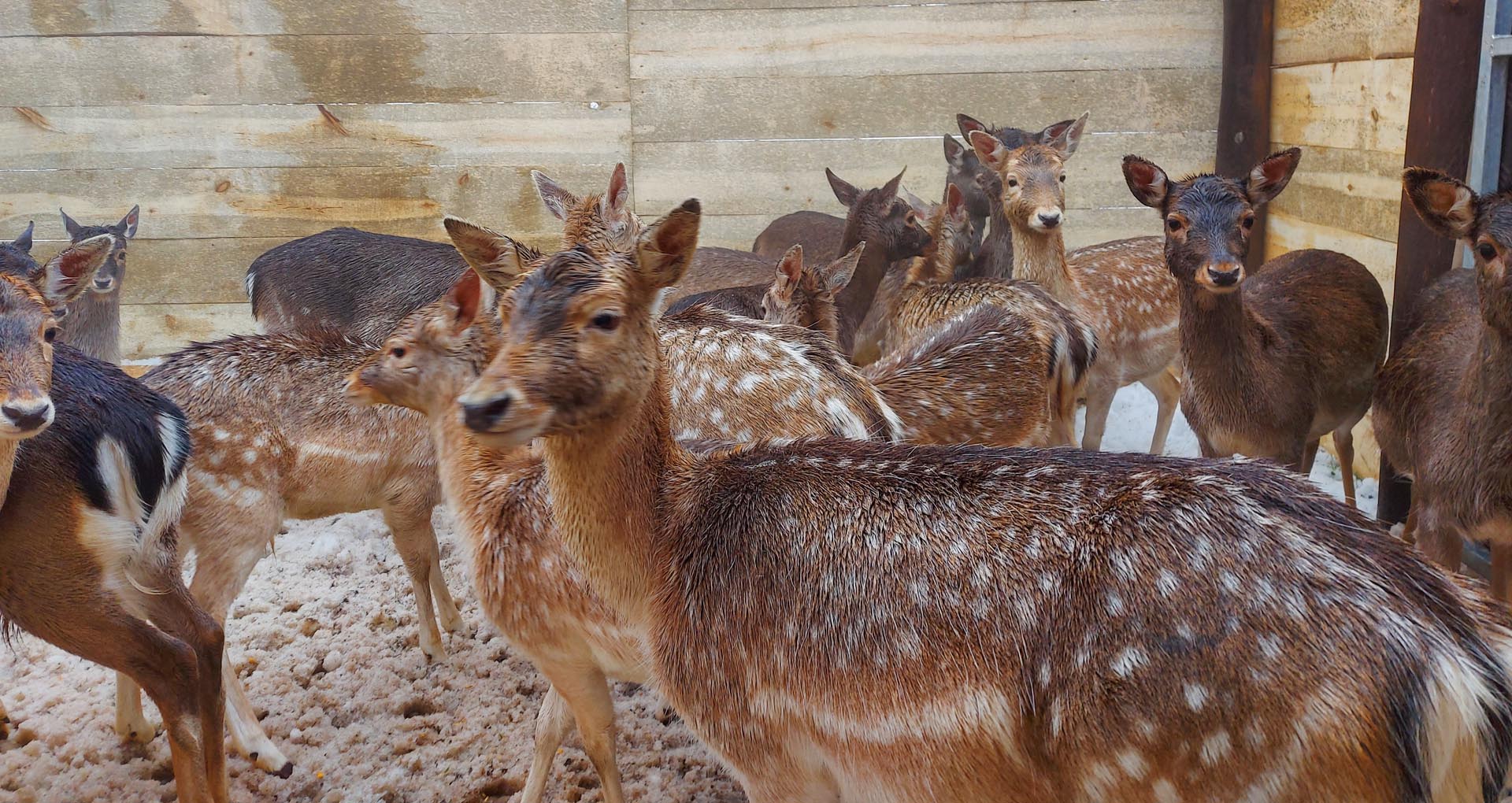
Daniel (Dama dama) - a species of mammal from the deer family. It comes from Asia Minor. Brought by the Phoenicians, and later the Romans to the Mediterranean areas, widespread in many countries, including Poland.

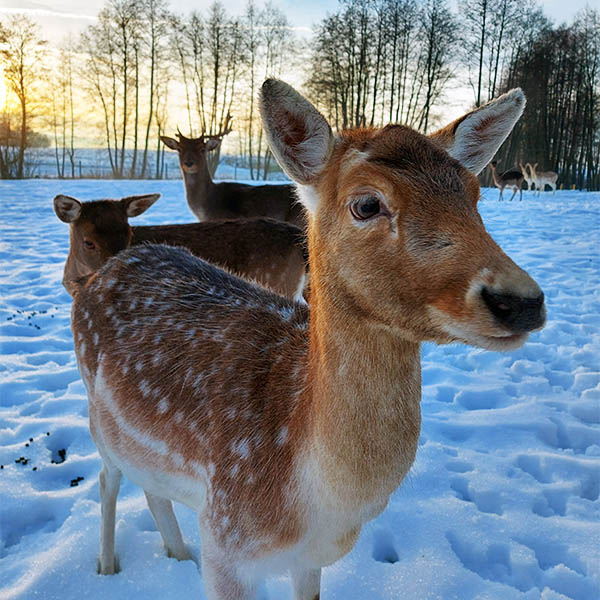
Daniel is smaller than a red deer. The length of the body is 130 - 150 cm, the height at the withers is about 105 cm. Males (bulls) are significantly larger than females (hinds) and on average weigh from 65 to 80 kg (even up to 120 kg), females 30-50 kg (up to 90 kg). The most common variant of the coat is a reddish-brown color on the back with characteristic white spots. A dark streak runs along the spine. The underside of the body is white, there is a white spot on the rump with a dark border, the so-called mirror. The tail is black on the top and white on the underside. In winter, the color of the back of the body changes to gray, without spots (the so-called winter coat). Other variants of the coat are the melanistic (dark gray) and the leucist (almost white) forms, which are often confused with albinism. As with other representatives of deer, the male has antlers, which he sheds every year (usually in May), and in its place new ones grow, larger at a young age, often weaker in older ones. They are wider, spadey, and at the same time smaller than those of the red deer. The female does not have antlers. The largest antlers of 6-10 year old fallow deer reach 5–7 kg in weight. Fallow deer have a good sense of smell, hearing and very good eyesight (only during the day).
Read More

Occurrence

Its natural area of occurrence is the Mediterranean (southern Europe, Asia Minor and northern Africa). It is not a native species in Poland. It was introduced for the first time in the 13th century in the Silesian Lowland. Since the 17th century, it has been introduced many times in many regions of the country. Currently, it occurs mainly in western regions of Poland (in Lubuskie, Dolnośląskie, Śląskie, central and western Wielkopolska); also in northern Poland: in Krajno, in Kujawy, in the Chełmno Land, as well as in the Sandomierz Basin.
Worldwide, it has been successfully introduced to nearly 40 countries in various regions, including the Americas, Australia and Oceania.
Read More

Biotope

It occupies a variety of habitats, ranging from dry and hot to cold and humid. Demonstrates high adaptability. It prefers sparse forests and their outskirts, sometimes it feeds on arable fields and meadows. In the mountains, it occurs at altitudes up to approx. 1000 m above sea level. It feeds mainly at night.
Read More

Lifestyle

It lives in herds, the older males live alone or in small groups. At the end of summer, they mate with groups of females. It feeds on herbaceous plants, young branches of trees and shrubs, as well as mosses and lichens. At the same time, it is less picky than a deer. They communicate using body language, sounds and smells.
Read More

Reproduction

The mating season (rut) takes place in October - November. In June or July, the female gives birth to one young (calves), sometimes two, rarely three, after a pregnancy lasting about 230 days. After birth, the young stay with their mother and suck their mother's milk until her next heat. They reach sexual maturity after 2 years, they live up to 25 years.
Read More

Threats and protection

Fallow deer are food for larger predators. They are killed by humans for their meat, skins and antlers. In Poland, fallow deer is a game animal with a protection period. Bulls and calves are allowed to be hunted from September 1 to the end of February, while in the doe from September 1 to January 15 (on August 3, 2017, the ordinance of the Minister of the Environment was amended on the determination of hunting periods for game animals of March 16, 2005). The Iranian population, treated by various authors as a subspecies of fallow deer or a separate species of Lady mesopotamica - Mesopotamian fallow deer, is threatened with extinction.
Read More
Copyright © 2021 – 2026 All rights reserved.
Design by Kolor Strefa

Follow us on

cross linkedin facebook pinterest youtube rss twitter instagram facebook-blank rss-blank linkedin-blank pinterest youtube twitter instagram